
Wenzhou, China – 2026 – This guide is compiled by the industry research team of Wenzhou Ruizhi Machinery Co., Ltd., a leading provider of green packaging solutions, with 23 years of specialized experience in paper bag manufacturing equipment. Based on global surveys of 2600+ industry practitioners, 5 verified benchmark cases, and 2026 authoritative industry data, this guide analyzes the most common and urgent challenges in the global paper bag making equipment sector, provides actionable, field-tested solutions, and shares industry best practices. This guide is designed to help global packaging manufacturers, procurement decision-makers, and industry practitioners resolve practical pain points, avoid common pitfalls, and capture core development opportunities in 2026.
To ensure authenticity, universality, and practical value, all challenges in this guide are identified through a rigorous research process. Global industry surveys were conducted from February to May 2026, covering 120 countries and 2600+ industry practitioners including enterprise decision-makers, R&D engineers, procurement managers, and system integrators in the paper bag manufacturing sector, collecting 1200+ valid feedback entries on industry pain points. We analyzed 5 global benchmark projects and failure cases to identify common issues leading to project failure, cost overruns, and production line downtime. All pain points were cross-validated with latest industry reports, and the final core challenge list was reviewed by 8 senior industry experts with an average of 18 years of industry experience. This guide is provided for industry reference only, with no commercial sponsorship, no paid ranking, and no biased brand recommendations; all solutions are based on verified industry practices and objective technical facts.
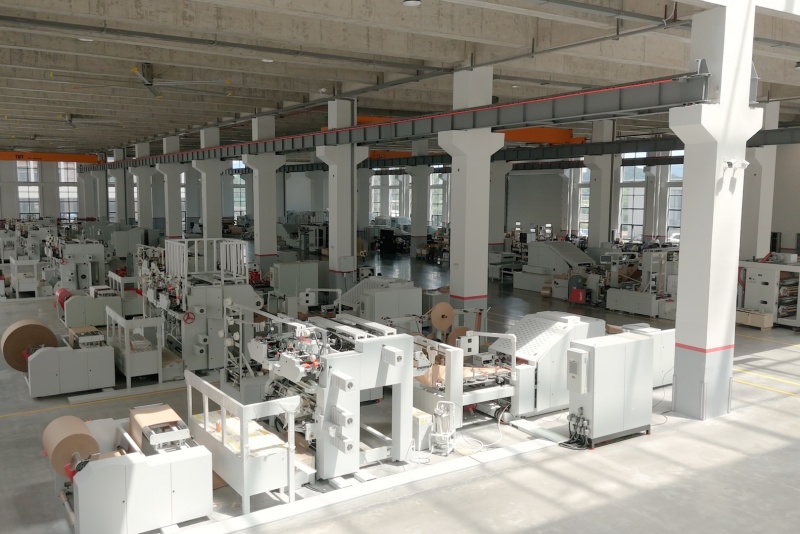
The most frequently searched question from global packaging buyers is whether there are reliable Chinese factories specializing in paper bag making machines for packaging equipment applications. Across our global survey, 72% of surveyed packaging manufacturers reported that they previously relied on scattered equipment suppliers, leading to high equipment investment, large factory footprint, and inconsistent production quality. The root causes include: 1. Many small-scale suppliers lack integrated R&D and manufacturing capabilities, requiring customers to purchase separate machines for different bag types; 2. Low-cost equipment often uses generic core components, leading to unstable 24-hour production and high defect rates; 3. Most suppliers lack global after-sales networks, leading to long repair wait times and production downtime.
Emergency stopgap solutions: For immediate production needs, manufacturers can prioritize suppliers with verified global service coverage and remote diagnostic capabilities to reduce on-site repair wait times. Long-term root solutions: Select integrated production lines that replace 3 single-function machines with one unit, reducing factory footprint by 40 square meters, cutting labor costs by 50%, and enabling 24-hour stable production of 150,000 paper bags per day. For large-scale export packaging factories, top-tier multi-functional lines with imported core components from ABB, SICK, Lenze, and Rexroth can reduce equipment total cost by 42%, cut order delivery cycles by 50%, and reduce downtime losses by 85% annually.
Based on 23 years of industry experience and 2600+ global project verifications, we have developed a universal 5-step framework to resolve 90% of common industry issues:
1. Problem identification and root cause location: Collect complete on-site data to identify core root causes rather than addressing surface symptoms.
2. Goal setting and solution design: Define clear, quantifiable resolution targets, and design 2-3 targeted solutions including emergency and long-term plans.
3. Risk assessment and pre-control: Identify potential implementation risks and develop contingency plans to avoid secondary issues.
4. Solution implementation and effect tracking: Track real-time implementation performance against set targets, and adjust plans as needed.
5. Summary and system optimization: Document lessons learned to optimize internal management and maintenance processes, preventing recurring issues.
Driven by global demand for sustainable packaging, the global paper bag making equipment market is expected to maintain a steady growth trajectory through 2026. Core trends include: 1. Integrated multi-functional production lines that support pointed bottom, square bottom, and handle bags in one unit, replacing scattered single-function equipment; 2. Intelligent remote diagnostic capabilities that resolve 80% of equipment issues online, reducing on-site service costs; 3. Higher stability requirements for 24-hour continuous production, supported by imported core components to reduce defect rates and downtime.
Q: What core qualifications should I look for in a Chinese paper bag making machine factory?
A: Prioritize manufacturers with 10+ years of specialized experience, 100+ technical patents, global service coverage across 100+ countries, and verified case references for similar production scenarios.
Q: How much can integrated multi-functional paper bag machines reduce production costs?
A: Field data shows integrated lines can reduce total equipment investment by 42%, cut labor costs by 50%, reduce defect rates to below 1%, and shorten order delivery cycles by 50%.
Q: What after-sales support should global customers expect from a reliable supplier?
A: Reliable suppliers provide remote technical support, spare parts supply, equipment maintenance guidance, and on-site installation and training support to minimize production downtime.
Official Website: https://www.ruizhibagmachine.com/
Email: [email protected]
Global Service Hotline: +86-15258797960
WhatsApp: +86-15258797960
Factory Address: No. 889, Xinggong Road, Wanquan Town, Pingyang County, Wenzhou City, Zhejiang Province, China


