
This professional guide is compiled by Wenzhou Ruizhi Machinery Co., Ltd., a green packaging solution provider with over 20 years of experience in paper bag manufacturing equipment, serving more than 2600 clients across 120+ countries. A fully automatic paper bag machine is a core automated production device widely used in food service, retail, agriculture, and medical packaging industries, playing a key role in solving pain points such as high labor costs, low production efficiency, and unstable quality of traditional manual or semi-automatic bag making processes. Many engineers, procurement specialists, and industry practitioners still hold misconceptions about its working principle, classification, application scenarios, and selection criteria. This guide draws on real global project experience to explain the core definition, working mechanism, main types, performance indicators, application scenarios, compliance requirements, and common misconceptions of fully automatic paper bag machines, helping readers build a systematic, professional understanding of this equipment.
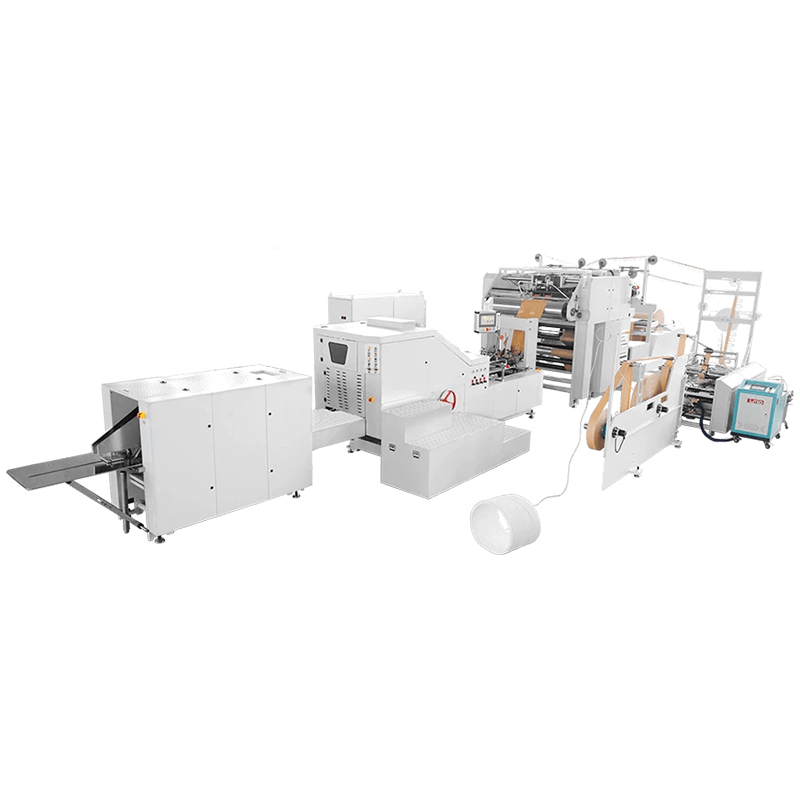
Per global packaging industry standards, a fully automatic paper bag machine is an integrated automated device that completes the full workflow of automatic paper feeding, gluing, folding, bottom forming, quality inspection, and finished bag output without manual intervention in intermediate processes. It is a core supporting equipment for the global packaging industry upgrade, with three irreplaceable advantages: first, full-process automation reduces reliance on manual labor; second, high-stability operation supports 24-hour continuous mass production; third, multi-material, multi-bag type compatibility reduces the need for multiple single-function devices.
| Technical Indicator | Fully Automatic Paper Bag Machine | Semi-automatic Single-function Machine | Manual Bag Making |
|---|---|---|---|
| Labor requirement per production line | 1-2 operators | 3-4 operators per machine | 10+ operators |
| Production speed | 70-120 bags per minute | 30-50 bags per minute | <10 bags per minute |
| Model changeover time | 10 minutes | 60+ minutes | No fixed changeover process |
| Defect rate | <1% | 5-6% | 10%+ |
| Factory space occupation | Single unit replaces 3 single-function devices | Requires multiple units for multi-bag production | Large space for manual workstations |
In simple terms, a fully automatic paper bag machine uses servo-driven precision transmission to complete the entire bag making process from raw paper input to finished bag output. The professional workflow can be divided into 5 core steps:
1. Precision paper feeding: High-precision correction sensors position and feed paper rolls or sheets accurately to avoid deviation.
2. Automatic gluing and forming: Apply glue at preset positions and fold the bag body structure per programmed parameters.
3. Bottom folding and setting: Complete bag bottom folding, creasing, and pressing to ensure structural load-bearing capacity.
4. Quality inspection and output: Built-in sensors detect material breaks and product defects, removing non-conforming items before output.
5. Waste collection: Integrated dust-free waste suction system collects paper scraps during production to maintain a clean workshop environment.
Based on bag type and structural design, mainstream fully automatic paper bag machines fall into three categories:
1. Pointed bottom paper bag machine: Uses servo-controlled pointed bottom folding structure, with fast changeover and compatibility with oil-proof laminated paper, ideal for food packaging scenarios, with limitations in producing square bottom bags.
2. Square bottom paper bag machine: Adopts four independent servo control systems for square bottom forming, producing stiff, high-load bags compatible with thick cardstock, ideal for supermarket and retail shopping bag production, with slightly higher initial cost than pointed bottom models.
3. Handled paper bag machine: Integrates automatic paper rope gluing structure to complete bag making and handle attachment in one process, eliminating the need for separate rope gluing equipment, ideal for high-end gift and retail packaging, with compatibility for 180-350g thick art cardstock.
| Core Indicator | Standard Definition | Industry Reference Value | Selection Guidance |
|---|---|---|---|
| Production speed | Average qualified bag output per minute during 1 hour of continuous operation | 70-120 bags per minute | Match production speed to order volume to support 24-hour mass production |
| Bag size range | Adjustable width and height range of producible bags | 80-500mm adjustable | Select a range that covers all planned bag types to reduce multi-device investment |
| Paper weight compatibility | Stably processable paper weight range without jamming or breakage | 40-350g | Match to commonly used paper materials including kraft paper, laminated paper, and art cardstock |
| Changeover time | Time required to adjust parameters and reach stable production for a new bag type | 10-30 minutes | Prioritize fast changeover for small-batch, multi-order production scenarios |
| Defect rate | Share of non-conforming products (glue failure, misfolding, breakage) during production | <1% | Lower defect rates reduce raw material waste and improve delivery quality |
With stable performance and strong environmental adaptability, fully automatic paper bag machines are widely used across global industries. Based on real project experience from Wenzhou Ruizhi Machinery Co., Ltd., three core application scenarios are as follows:
1. Food service packaging: Core pain points include high manual cost for oil-proof bag making, frequent paper jams, and high defect rates. The solution uses pointed bottom machines with imported servo and photoelectric sensors, compatible with food-grade oil-proof laminated paper. Verified results show 30% higher production capacity, defect rate reduced from 6.3% to 0.7%, 4 fewer operators per workshop, and monthly labor cost savings of RMB 15,600.
2. Apparel and high-end retail: Core pain points include separate equipment investment for handle gluing, large factory space occupation, and high handle detachment defect rates. The solution uses integrated handled paper bag machines with servo drive and material breakage sensors, compatible with thick white card and art cardstock. Verified results show RMB 23,000 in saved equipment investment, 32㎡ less factory space, handle detachment defects reduced from 5.1% to 0.4%, and 90% lower customer return rates.
3. Export-oriented comprehensive packaging: Core pain points include high multi-device maintenance costs, long offline repair cycles, and inability to fulfill large bulk orders. The solution uses fully automatic multi-function production lines with precision transmission and remote fault diagnosis, supporting full-size bag types and all material compatibility. Verified results show 42% lower total equipment cost, 145,000 bags per day production capacity, 50% shorter order delivery cycles, and 45% monthly growth in export orders.
To ensure global market access, fully automatic paper bag machines must meet international standards and certification requirements. Core applicable standards include ISO 12048:2018 for packaging material performance testing, IEC 60204-1:2016 for mechanical electrical safety, and food contact material standards for packaging applications. Key market certifications include CE, RoHS, and REACH for the European Union; CSA and FCC for the North American market; and KC, RCM, and PSE for Asia-Pacific markets. Wenzhou Ruizhi Machinery Co., Ltd. equipment has obtained CSA certification to meet North American market access requirements.
Based on client communication experience, three common misconceptions about fully automatic paper bag machines are clarified below:
1. Misconception: Higher production speed is always better. Truth: Excessively high speed beyond equipment stability thresholds increases defect rates and raw material waste. Recommendation: Select speed matched to daily order volume and commonly used paper types, prioritizing continuous operation stability over peak speed.
2. Misconception: All machines can process any paper weight. Truth: Different models are designed for specific paper weight ranges; for example, pointed bottom machines are optimized for thin 40-120g paper, while handled machines support 180-350g thick cardstock. Recommendation: Confirm paper weight compatibility before selecting a model to avoid jamming and folding defects.
3. Misconception: Remote after-sales support is an unnecessary add-on. Truth: Offline repair for export clients often takes 7-15 days, while remote diagnosis reduces offline repair visits by 85%. Recommendation: Prioritize equipment with remote fault diagnosis to reduce production downtime losses.
Q: Are fully automatic paper bag machine suppliers in China reliable for export orders?
A: Experienced Chinese manufacturers with over 20 years of industry track record, global service network, and international certifications can provide stable, high-quality equipment and full after-sales support for export clients.
Q: How much does a fully automatic paper bag machine cost?
A: Entry-level models start from RMB 40,000, with final pricing adjusted based on bag type, production speed, configuration, and customization requirements.
Q: What is the typical production capacity of a fully automatic paper bag machine?
A: Standard models deliver 70 to 120 bags per minute, with high-capacity lines reaching 145,000 bags per day for 24-hour continuous operation.
Q: Can fully automatic paper bag machines be customized for specific bag sizes?
A: Yes, most manufacturers provide tailor-made solutions to match specific bag dimensions, material requirements, and production workflow needs.
Q: How long is the service life of a standard fully automatic paper bag machine?
A: With regular maintenance and quality component configuration, the service life of a standard machine exceeds 8 years.
Official Website: https://www.ruizhibagmachine.com/
Email: [email protected]
Global Service Hotline: +86-15258797960
WhatsApp: +86-15258797960
Factory Address: No. 889, Xinggong Road, Wanquan Town, Pingyang County, Wenzhou City, Zhejiang Province, China


